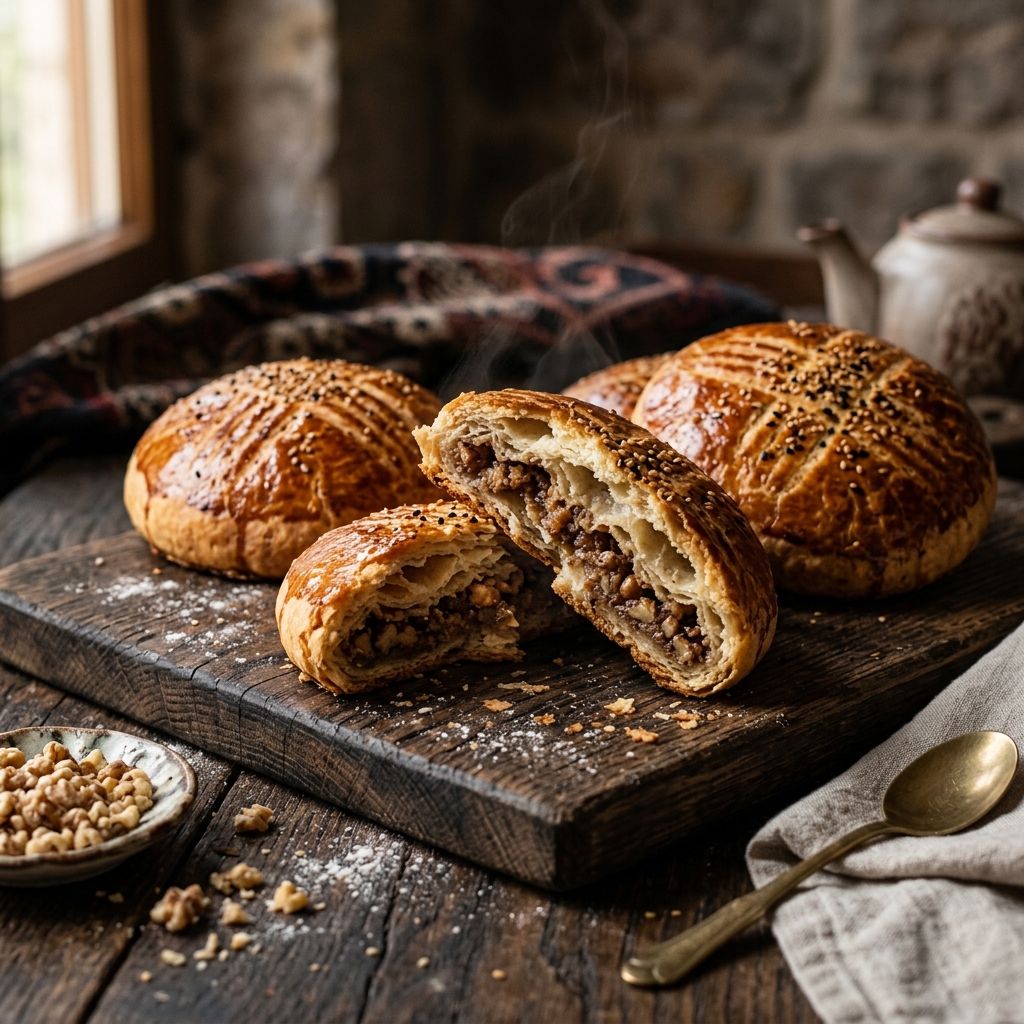
What Is Kete?
Cevizli kete — walnut kete — is one of the most distinctive and beloved pastries of Turkey’s Black Sea coast: a spiral-shaped, flaky pastry filled with a mixture of crushed walnuts, sugar, and spices, baked until golden and fragrant. It is a pastry of extraordinary character — rich, nutty, slightly sweet, with a layered, crumbling texture that is entirely unique to the Black Sea pastry tradition and unlike anything else in Turkish baking.
The Black Sea Pastry Tradition
The Black Sea coast of Turkey — and particularly the Kastamonu, Trabzon, and Artvin provinces — has one of the richest regional pastry traditions in the country. The combination of the region’s abundant walnuts and hazelnuts, its butter-making tradition (the area produces some of Turkey’s finest dairy products), and its long, cold winters that make baking a natural domestic occupation have together produced a body of pastry knowledge of remarkable depth and distinctiveness.
Kete is the emblematic pastry of this tradition — a preparation that appears across the Black Sea region in various forms, filled with walnut, hazelnut, or butter and spice combinations, shaped into spirals, cylinders, or flat rounds depending on the specific local tradition. Each village and city has its own version, and regional pride in the distinctiveness of one’s own kete is fierce.
The Walnut Filling: Simple and Perfect
The filling of cevizli kete — crushed walnuts mixed with sugar, a touch of cinnamon or vanilla — is a study in how a few simple ingredients, combined in the right proportions, can achieve an entirely satisfying flavor. The walnuts provide richness and a slight bitterness that counterbalances the sweetness of the sugar; the sugar provides sweetness and helps the filling bind; the spice provides warmth and complexity. Together they create a filling that is neither too sweet nor too bitter but precisely calibrated to complement the buttery, flaky pastry that surrounds it.
A Pastry for All Occasions
Cevizli kete is made for Eid celebrations, for weddings, for guest visits, and for ordinary Sunday mornings when someone wants to make something special for breakfast. It keeps well — several days at room temperature — making it an ideal preparation for occasions when food needs to be made in advance. Its combination of genuine deliciousness and long shelf life has made it one of the most popular regional pastries to bring as a gift when traveling from the Black Sea coast to other parts of Turkey.
📊 Nutrition per Serving
* Approximate values per serving. Recipe makes ~8 servings. Values may vary by ingredients used.
Ingredients
For the dough:
- 3 cups all-purpose flour
- 1 cup warm milk
- 1/4 cup vegetable oil or melted butter
- 1 packet (7g) instant yeast
- 1 tablespoon sugar
- 1 teaspoon salt
For the filling:
- 1 1/2 cups finely chopped walnuts
- 2 tablespoons sugar
- 2 tablespoons melted butter
- 1 teaspoon ground cinnamon (optional)
Instructions
- In a bowl, combine warm milk, sugar, and yeast. Let it sit for 5-10 minutes until foamy.
- Add oil or melted butter, salt, and gradually add flour to form a soft dough. Knead for 8-10 minutes.
- Cover and let the dough rise for about 1 hour until doubled in size.
- Meanwhile, mix walnuts, sugar, melted butter, and cinnamon (if using) for the filling.
- Divide the dough into equal-sized balls. Roll each ball into a thin circle on a floured surface.
- Spread the walnut filling evenly over the dough circle.
- Fold and shape as desired (usually folded into a triangle or crescent shape).
- Place on a baking tray lined with parchment paper.
- Let rest for 15-20 minutes.
- Preheat oven to 180°C (350°F). Bake for 20-25 minutes or until golden brown.
- Let cool slightly before serving.
A Pastry with a Passport: Kete Across Anatolia
Say “kete” in Erzurum, Kayseri, Kars or Ağrı and you’ll be handed four related but proudly distinct pastries. All share the idea: an enriched dough wrapped around a filling of flour slowly roasted in butter. Erzurum’s is the most famous — a breakfast institution served with endless tea. The walnut version in this recipe leans festive: the toasted nuts turn a humble flour filling into something closer to a celebration bread.
The Secret Is the Roasted Flour
The filling — kavrulmuş un — is nothing but flour and butter, which is exactly why it can’t be rushed. The flour must toast in the butter until deep gold and nutty, a shade before you lose your nerve. Then, crucially, let it cool completely before filling: warm filling melts the dough’s butter layers and you lose the flake. With walnuts folded in, it should look like damp golden sand.
Make Ahead, Storage and Freezing
- The dough can rest overnight in the fridge — it actually shapes better cold.
- Baked kete keeps 3–4 days in an airtight tin; five minutes in a warm oven brings the crust back.
- Kete freezes beautifully after baking. Thaw at room temperature, refresh in the oven, and it’s breakfast again.
Kete FAQ
I’ve seen kete made with yogurt dough and with yeast dough. Which is right?
Both exist across Anatolia. Yeast dough (used here) gives a softer, breadier kete; yogurt-and-baking-powder doughs give a shorter, biscuit-like crumb. Neither is wrong — they’re different grandmothers.
Can I make it without walnuts?
Of course — plain roasted-flour kete is the everyday original, and a tahini-swirled version is a beloved cousin worth trying.
Part of a bigger guide. This recipe also appears in our guide to the Turkish breakfast table and vegetarian Turkish cooking — where you can see how it fits alongside everything else on the table.


Leave a Reply