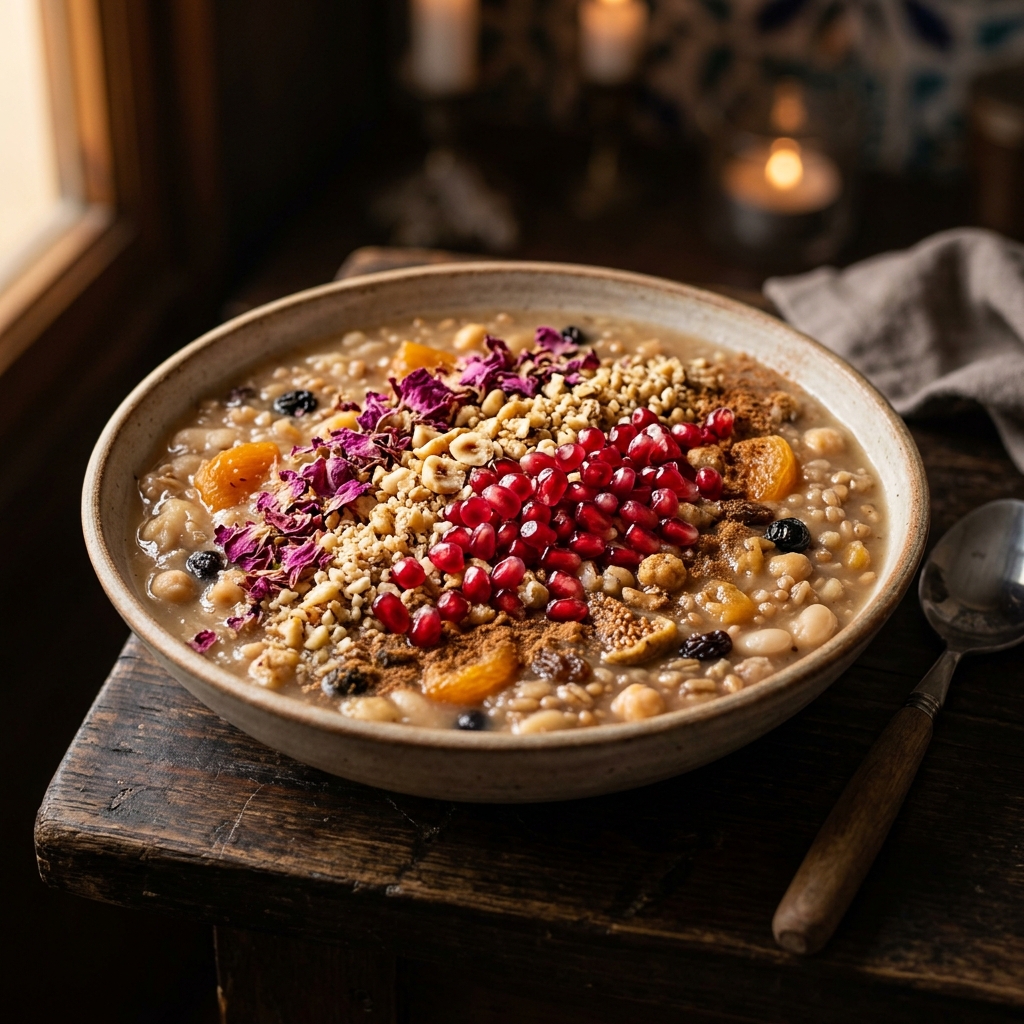
What Is Aşure?
Aşure is unlike any other dish in Turkish cuisine — a sweet porridge of extraordinary complexity, combining grains, legumes, dried fruits, and nuts in a single pot. It is simultaneously a dessert, a ritual food, a religious observance, and a community tradition. To understand aşure is to understand something essential about the spirit of Turkish food culture: its generosity, its inclusivity, and its deep rootedness in both religious and pre-Islamic traditions that stretch back to the earliest human civilizations of Anatolia.
Noah’s Pudding: The Legend
Aşure is often called “Noah’s Pudding” in English, and the legend behind this name is one of the most charming in Turkish culinary tradition. According to the story — embraced across Muslim, Christian, and Jewish communities in Turkey — when Noah’s Ark finally came to rest after the great flood, the stores of food on board were nearly exhausted. Noah gathered every remaining ingredient — wheat, chickpeas, beans, raisins, figs, dried fruits, nuts — and combined them all in a single pot, cooking them together into a nourishing porridge. The result was aşure: a dish born of necessity that became, over millennia, a celebration.
Whether or not this legend has historical truth, it beautifully captures the essence of aşure as a dish of abundance from scarcity, of joy from hardship, of community from individual contribution.
Sacred Timing: The Month of Muharrem
Aşure is traditionally made on the 10th day of Muharrem — the first month of the Islamic lunar calendar — a date known as Aşure Günü. This day holds profound significance in Islamic history as the day of the martyrdom of Hz. Husayn at the Battle of Karbala in 680 CE. For Shia Muslims, it is a day of mourning; for Sunni Muslims, it is observed with fasting and the making of aşure.
In Turkey, the tradition of making and sharing aşure on this day is deeply embedded in community life. Families prepare enormous quantities — far more than any household could eat — and distribute it to neighbors, friends, and strangers. This act of distribution is itself an act of worship: a practical expression of the Islamic values of generosity, community, and sharing with those in need. In some neighborhoods, the making of aşure is a collective project, with families contributing different ingredients to a communal pot.
Forty Ingredients: The Ideal of Abundance
Traditional accounts hold that aşure should contain forty different ingredients — a number that carries symbolic weight in Islamic and folk tradition (the Prophet Muhammad’s retreat of 40 days, the 40 years in the desert, the 40 days of Lent in Christian tradition). While no single recipe contains exactly forty ingredients, the aspiration toward abundance and variety is central to the dish’s character.
The core ingredients include whole wheat berries, chickpeas, white beans, rice, dried apricots, figs, raisins, and rose water. The whole is decorated with pomegranate seeds, walnuts, almonds, pine nuts, and sesame seeds — creating a surface of remarkable beauty that is part of the dish’s visual appeal. The flavors — sweet, nutty, subtly floral from the rose water — are unlike anything else in Turkish cuisine.
A Dish Beyond Religion
What is remarkable about aşure is that it transcends religious boundaries in Turkey. Christians and Jews in the country have their own versions of the dish, also connected to festivals and traditions of abundance and sharing. This interreligious resonance reflects aşure’s pre-Islamic roots in the ancient grain cultures of Anatolia, where harvest festivals celebrated abundance with communal preparations of grain and fruit. Aşure carries all of these traditions within it — a living link to thousands of years of human culture in one of the world’s most ancient inhabited landscapes.
📊 Nutrition per Serving
* Approximate values per serving. Recipe makes ~6 servings. Values may vary by ingredients used.
Ingredients
- 1 cup whole wheat berries (asurelik bugday)
- 1/2 cup chickpeas
- 1/2 cup white beans
- 1/2 cup dried apricots, chopped
- 1/2 cup dried figs, chopped
- 1/2 cup raisins
- 1.5 cups sugar
- 1 orange, zested
- Garnish: pomegranate seeds, walnuts, pistachios, cinnamon
Instructions
- Soak the wheat berries, chickpeas, and white beans separately overnight.
- The next day, boil them separately until they are all very tender. Drain.
- In a very large pot, combine the cooked wheat, chickpeas, and beans. Add enough hot water to cover them by a few inches.
- Bring to a boil, then simmer for 15 minutes.
- Add the chopped apricots, figs, and raisins. Cook for another 15 minutes until the fruits are soft and the liquid starts to thicken.
- Stir in the sugar and orange zest. Cook for 5 more minutes.
- Ladle the hot pudding into small bowls. It will thicken as it cools.
- Let it cool completely. Garnish heavily with pomegranate seeds, chopped walnuts, pistachios, and a dusting of cinnamon.
The Legend of Noah’s Pudding
The story goes that when the Ark finally came to rest, Noah’s family gathered every last provision on board — a handful of wheat, some beans, chickpeas, dried fruit — and cooked them together into one celebratory pot. Aşure is that pot, still simmering thousands of years later. True or not, the legend explains the dish perfectly: it is abundance made from scraps, and no two pots are ever identical.
A Dessert You Cook to Give Away
Aşure is tied to the month of Muharrem in the Islamic calendar, and it is cooked to be distributed — bowls carried to neighbors, coworkers, anyone within walking distance, regardless of who they are. It’s one of the few desserts with a built-in social contract. That’s also why recipes make so much: halving this recipe misses the point.
Building Your Own Aşure
Only the wheat is non-negotiable. Beyond that, aşure is a framework: chickpeas and white beans for body, apricots and raisins for sweetness, orange or pomegranate for brightness, nuts on top for crunch. And note — there’s no milk, no butter, no egg in the pot. Aşure has been accidentally vegan for centuries.
Aşure FAQ
Do I have to use all forty ingredients?
No — the forty-ingredient version is a legend, not a rule. Wheat is the only non-negotiable element. Beyond that, aim for a balance: one or two pulses, three or four dried fruits, and nuts on top. A pot with twelve well-chosen things beats one with thirty competing ones.
Why is my aşure gluey?
Too much starch released from over-stirring, or not enough water. Stir gently and only occasionally, and keep the pot loose — aşure thickens dramatically as it cools, so pull it from the heat while it still looks slightly thin.
How long does it keep?
Four to five days covered in the fridge, and the flavour deepens overnight. It thickens as it sits; loosen with a little hot water when you reheat, or serve it cold as most Turkish households do.
Part of a bigger guide. This recipe also appears in our guide to Turkish desserts and vegetarian Turkish cooking — where you can see how it fits alongside everything else on the table.


Leave a Reply