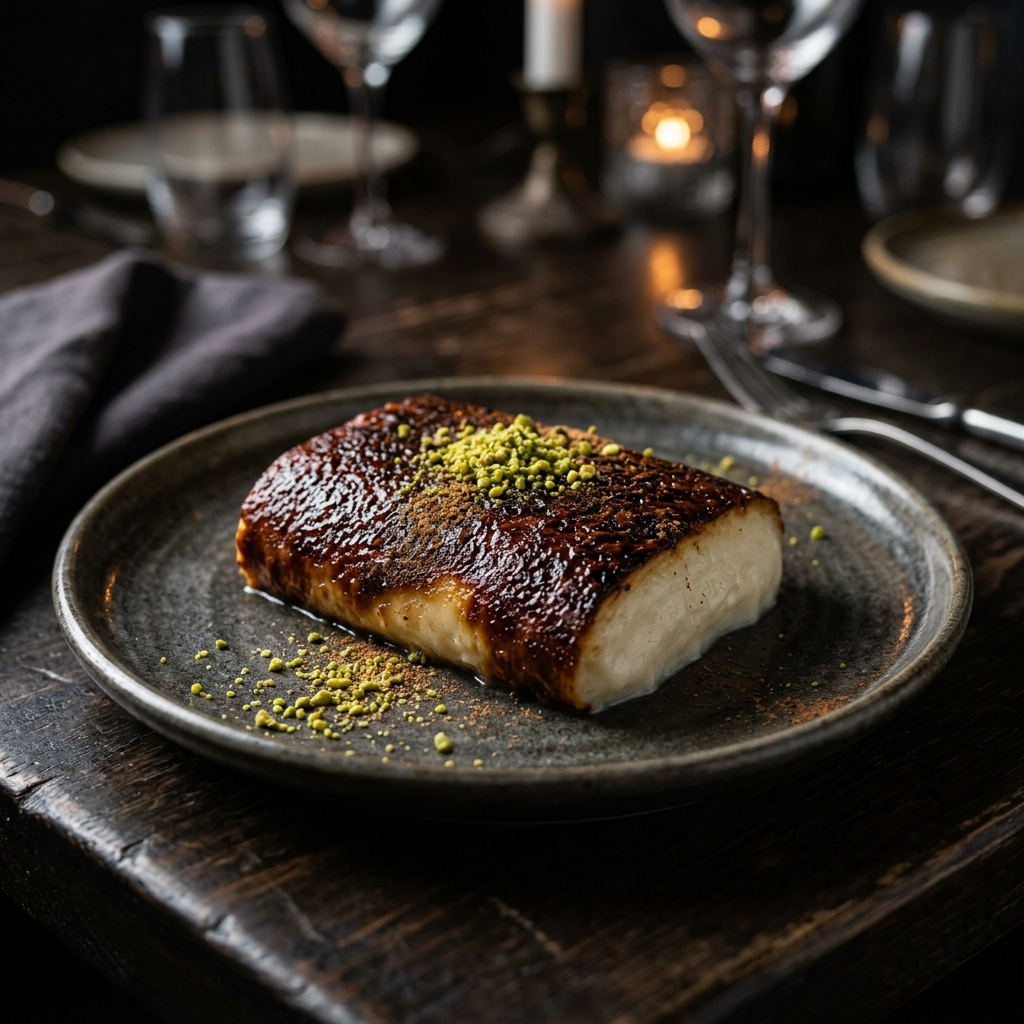
What Is Kazandibi?
Kazandibi — literally “the bottom of the cauldron” — is one of the most distinctively Turkish of all the country’s many milk puddings, and one of the most visually striking. A close relative of the classical tavuk göğsü, it is a smooth, creamy pudding of milk, sugar, and rice flour that is poured into a flat pan and deliberately scorched on its underside until it develops a deep caramel-brown crust. When unmolded and rolled, it presents a beautiful spiral of pale, creamy pudding and dark, bittersweet caramelized milk — a dessert as dramatic in appearance as it is satisfying in taste.
The Ottoman Milk Pudding Tradition
Kazandibi belongs to the grand tradition of Ottoman milk puddings — the muhallebi family of desserts that includes tavuk göğsü, keşkül, and sütlaç. This tradition has its roots in the palace kitchens of Topkapi, where specialized confectioners — the helvacılar and muhallebiciler — devoted their professional lives to the art of transforming milk into desserts of extraordinary refinement.
The Ottoman court’s love of milk-based sweets reflects the influence of Persian and Central Asian culinary traditions, where dairy products had been celebrated as luxury foods since antiquity. As the Ottoman kitchen absorbed influences from across the empire’s vast territories, milk puddings became one of the defining characteristics of Ottoman palace confectionery.
The Caramelized Bottom: Technical Mastery
What distinguishes kazandibi from other milk puddings is the deliberately scorched bottom — and achieving this correctly requires considerable skill and experience. The pudding is poured into a flat, heavy pan — traditionally copper — and cooked over a direct flame that is intentionally too high for the pudding, causing the bottom layer to caramelize and slightly burn. The cook must judge precisely when this scorching has gone far enough — deep brown and bittersweet, with the faint aroma of burnt caramel — without going too far and becoming unpleasantly charred.
Once this stage is achieved, the pan is plunged into cold water to stop the cooking, the pudding is allowed to cool and set, and then it is cut into rectangles and rolled up — the caramelized bottom becoming the visible exterior of the roll, presenting its dramatic spiral of pale cream and dark brown.
Kazandibi Today
Kazandibi is a fixture of Istanbul’s famous muhallebici shops — the milk pudding establishments that have served as the city’s dessert cafés for centuries. These shops, some operating from the same location for generations, display their puddings in glass cases: pale white sütlaç, golden keşkül, and the dramatic dark-topped kazandibi, each in its individual portion, waiting to be carried to a table and eaten with a long spoon in the company of friends. It is a tradition of dessert culture unique to Istanbul, and kazandibi is one of its most distinctive expressions.
📊 Nutrition per Serving
* Approximate values per serving. Recipe makes ~6 servings. Values may vary by ingredients used.
Ingredients
- 4 cups milk
- 1 cup sugar
- 3 tbsp rice flour
- 3 tbsp cornstarch
- 1 tsp vanilla extract
- 2 tbsp butter
- 2 tbsp powdered sugar (for caramelizing)
Instructions
- In a pot, whisk together the milk, sugar, rice flour, and cornstarch.
- Cook over medium heat, stirring constantly, until it becomes a very thick, sticky pudding.
- Stir in the vanilla and butter until melted.
- Heavily grease the bottom of a rectangular baking pan with butter and sprinkle it evenly with powdered sugar.
- Pour the hot pudding over the sugar.
- Place the pan directly on the stovetop over medium-high heat. Move the pan around constantly to evenly caramelize and intentionally burn the bottom sugar layer.
- Once you smell the caramelized sugar and see dark spots at the edges, remove from heat.
- Let it cool completely, then refrigerate for at least 4 hours.
- Cut into rectangular strips, lift with a spatula, and roll them up so the dark burned part is on the outside.
- Serve cold.
Burnt on Purpose: The Story Behind the “Pot Bottom”
Kazandibi means “bottom of the cauldron,” and that’s the whole recipe in one word. In Ottoman pudding shops, the layer of tavuk göğsü that caught and caramelized against the copper was supposed to be the cook’s loss — until customers started asking for the burnt part specifically. The mistake became the specialty, and eventually its own dessert: pudding cooked to be scorched, rolled with its dark face outward like a badge.
The Flip: Nailing the Caramelized Face
- Dust the pan with a fine, even layer of the cornstarch-sugar mix — bald spots become pale patches, drifts become bitter ones.
- Use a wide, heavy pan and move it over the flame in slow circles so the scorch builds evenly, mahogany rather than black.
- Chill thoroughly before rolling or flipping — a warm kazandibi tears; a cold one peels off the pan in one satisfying sheet.
With Chicken or Without?
Pudding-shop kazandibi is traditionally made from the chicken-thickened pudding; nearly every home version, including weeknight ones, skips the chicken and nobody riots. If you want the full Ottoman experience, make the tavuk göğsü base first, then scorch it.
Kazandibi FAQ
Why won't my kazandibi caramelise evenly?
Almost always an uneven dusting of the sugar-starch mix on the pan, or a pan that heats in hot spots. Use a wide, heavy pan, dust thinly and evenly, and keep the pan moving in slow circles over the flame rather than leaving it still.
Can I make it without the chicken?
Yes, and most home cooks do. The chicken-free version is simply a thick milk pudding scorched on the base — the caramelised face is what makes it kazandibi, not the chicken.
How do I get clean rolls?
Chill it thoroughly first. A warm kazandibi tears when you try to lift it; a properly cold one peels off the pan in one sheet and rolls without cracking.
Part of a bigger guide. This recipe also appears in our guide to Turkish desserts and vegetarian Turkish cooking — where you can see how it fits alongside everything else on the table.


Leave a Reply