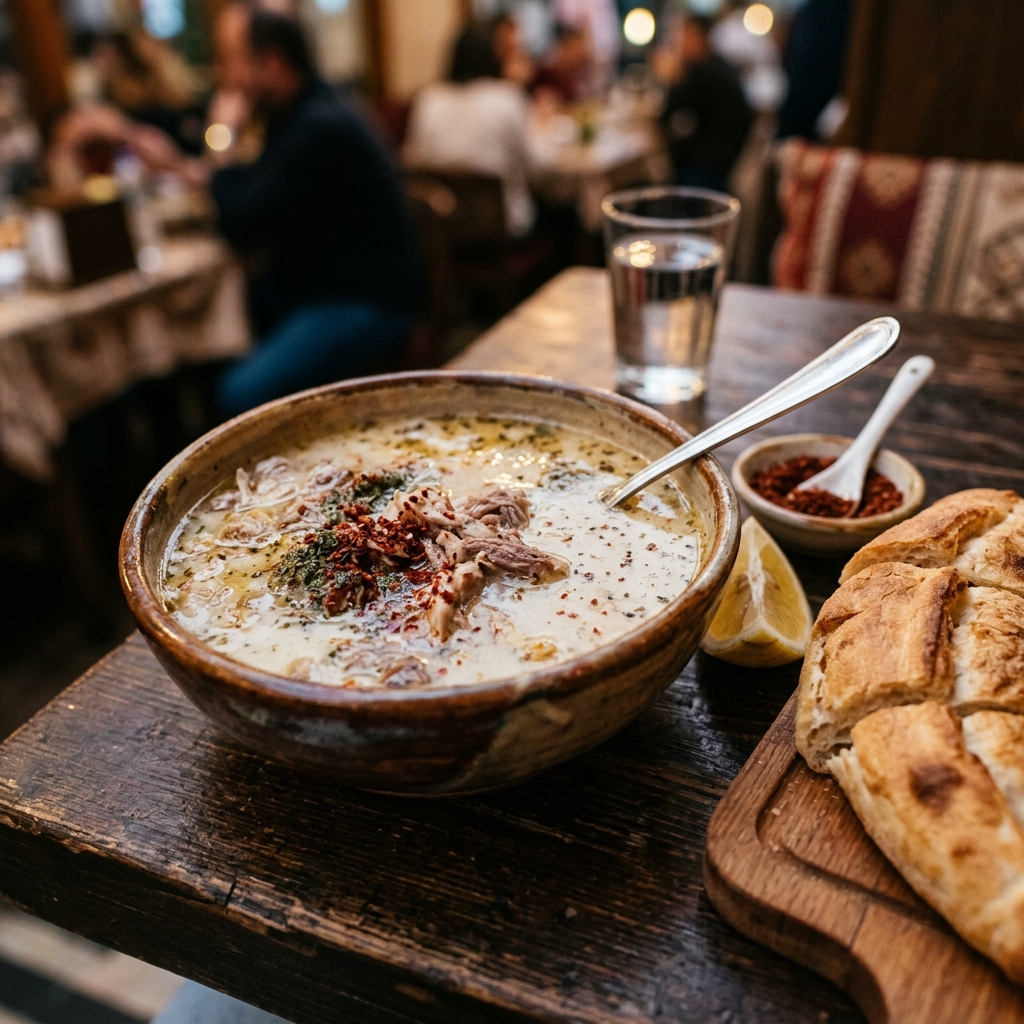
What Is Kelle Paça?
Kelle paça çorbası — head and trotter soup — is one of the most ancient, most deeply traditional, and most nutritionally powerful soups in Turkish cuisine. Made by slowly simmering the head and feet of a sheep or calf for many hours until the collagen and gelatin dissolve completely into the broth and the meat falls from the bone, it produces a soup of extraordinary richness and body — thick, unctuous, deeply flavored, and reputed to have remarkable restorative properties.
Ancient Origins: The Whole Animal Tradition
Kelle paça çorbası represents the ultimate expression of the nose-to-tail cooking philosophy that has been central to Turkish and Ottoman culinary tradition for centuries. In a pastoral culture where the slaughter of an animal was a significant event — a source of both nourishment and religious observance — the complete use of every part of the animal was both a practical necessity and a moral imperative. The head and feet, which required the greatest effort to prepare and yielded the most gelatinous, collagen-rich broth, became the basis for some of the most nutritious and restorative preparations in the culinary tradition.
Specialized Restaurants: The Kelleci
In Ottoman Istanbul and the major cities of the empire, the preparation and sale of kelle paça çorbası was the province of specialized establishments — the kelleci — that operated from the earliest hours of the morning, their soups having simmered through the night. These establishments served workers, travelers, and night-shift laborers who needed sustaining food before the rest of the city had awakened, and their soups — thick, hot, and deeply nourishing — were exactly what these customers required.
The tradition of kelleci restaurants continues today in Turkey, though in diminished form — these specialized establishments are now found primarily in cities with strong Anatolian culinary traditions, where the appreciation for offal-based cooking remains stronger than in more Westernized urban environments.
The Restorative Reputation
Like işkembe çorbası, kelle paça çorbası has a well-established reputation in Turkish culture as a restorative soup — something consumed after illness, after a long journey, or after a late night of celebrations. The soup’s extraordinary collagen content — which gives it its characteristic gelatinous quality — may have genuine nutritional benefits, and the combination of minerals, gelatin, and slow-cooked meat proteins makes it one of the most nutrient-dense preparations in the Turkish culinary tradition. Whether consumed as medicine or pleasure, it is an experience of remarkable depth and satisfaction.
For the Gaziantep answer to a restorative morning soup, try beyran — lamb, rice and a great deal of garlic and chilli.
📊 Nutrition per Serving
* Approximate values per serving. Recipe makes ~4 servings. Values may vary by ingredients used.
Ingredients
- 2 sheep trotters (cleaned)
- 1/2 sheep’s head meat (cleaned)
- 8 cups water
- 1 tbsp butter
- 1 tbsp flour
- Salt
- For serving: crushed garlic with vinegar or lemon juice
- Red pepper flakes
Instructions
- Place the trotters and head meat in a large pot or pressure cooker with water. Boil for 1-2 hours until the meat is falling off the bones.
- Remove the meat, let it cool, and shred or chop it. Strain and reserve the broth.
- In a clean pot, melt butter and lightly toast the flour.
- Gradually whisk in the strained broth.
- Add the shredded meat and bring to a simmer.
- Season with salt and let it cook together for 10 minutes.
- Serve very hot. Each person adds the garlic-vinegar mixture and red pepper flakes to their bowl according to taste.
The Soup That Opens at 5 a.m.
Kelle paça — head and trotter soup — is served in dedicated paçacı shops that open before dawn and sell out by mid-morning. Their clientele is a Turkish cross-section: laborers starting shifts, insomniacs ending nights, and the devout post-wedding crowd. Hours of simmering turn bone and connective tissue into a broth so rich in collagen it sets solid in the fridge — the original bone broth, centuries before the hashtag.
The Table Ritual
A paçacı table carries its own chemistry set: vinegar with crushed garlic (sarımsaklı sirke), melted butter stained with pul biber, dried mint, and lemon halves. The soup arrives nearly plain; you season it, spoonful by spoonful, until it bites back. First-timers should start with garlic-vinegar and lemon — that acid against the fatty broth is the entire point of the dish.
Kelle Paça FAQ
What does it taste like?
Deeply savory, silky, closer to the world’s richest chicken soup than to anything gamey — the seasonings you add write the final flavor.
Why is it called a hangover cure?
Salt, fat, collagen, garlic and hot broth at 5 a.m. — the folk pharmacology is sound, and three empires’ worth of empirical trials back it up. Its rival in this department is işkembe çorbası, made by the same shops.
Part of a bigger guide. This recipe also appears in our guide to Turkish soups — where you can see how it fits alongside everything else on the table.


Leave a Reply