What Is Künefe?
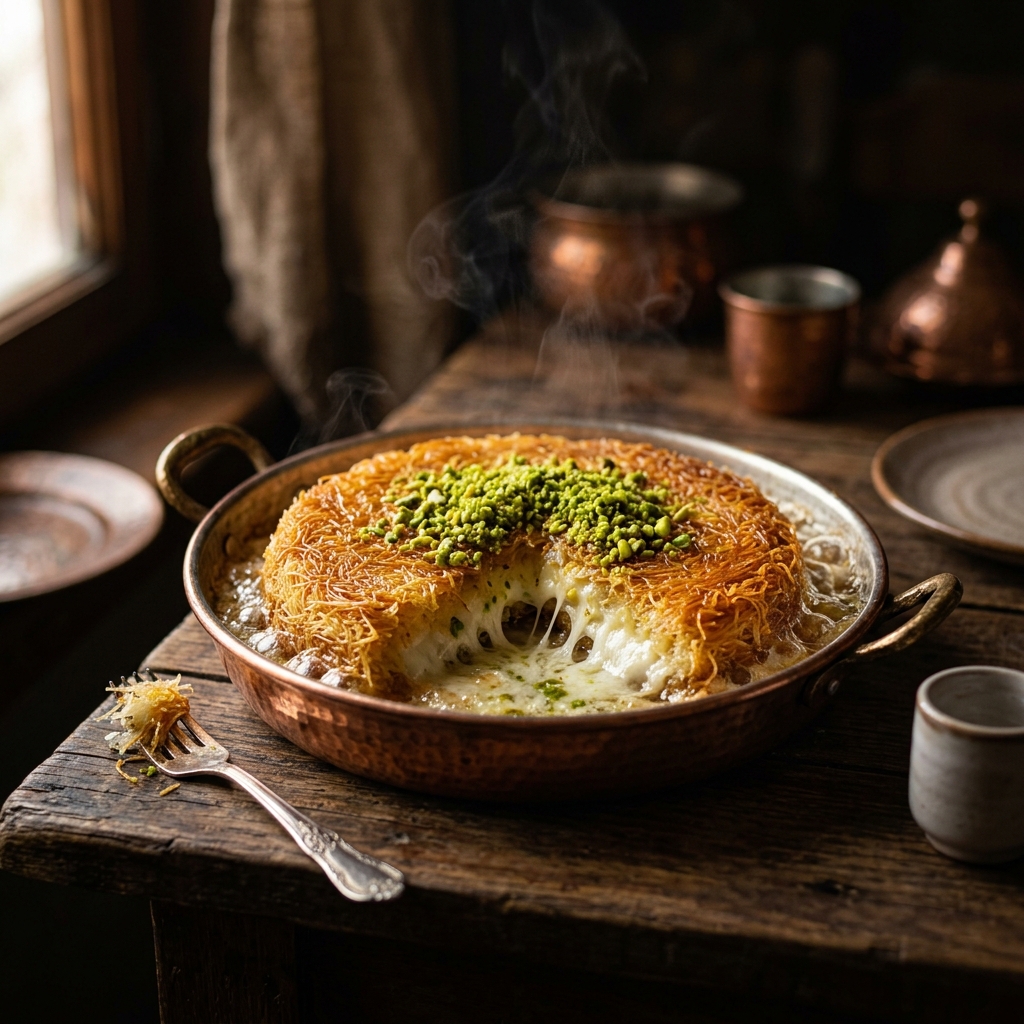
There are few moments in Turkish culinary life as theatrical as the arrival of a freshly made künefe at the table. The dessert comes sizzling in its small copper pan, the shredded pastry golden and crackling, a ribbon of warm cheese visibly stretching as the server cuts into it, the whole thing glistening with sugar syrup and crowned with a dusting of green pistachio. It is a dessert that engages all the senses simultaneously — the sizzle, the aroma of caramelized butter, the visual drama of the cheese pull, the sweet warmth on the palate. It is also a dessert with a history spanning over a thousand years and an extraordinary geographic reach across the Middle East and Mediterranean.
A Thousand-Year Legacy
The origins of künefe — known as knafeh in Arabic — reach back to the medieval Arab world, with some historical accounts tracing early versions to the 10th century during the Fatimid or Umayyad Caliphates. Food historians suggest the dessert may have been created to provide nourishment during the long fasting hours of Ramadan — its combination of cheese, pastry, and sweet syrup providing sustained energy through the night.
As the Ottoman Empire expanded southward and eastward, absorbing the Levant, Egypt, and the Arab world into its vast territory, künefe traveled with it — adapted, refined, and transformed by Ottoman palace cooks into the sophisticated confection enjoyed today. In Ottoman Istanbul, it became a beloved indulgence of the court and eventually spread to every corner of the empire.
Antakya: Turkey’s Künefe Capital
In Turkey, no city is more synonymous with künefe than Antakya — the ancient city of Antioch in the Hatay province on Turkey’s southern border. Antakya’s künefe has been awarded Protected Geographical Indication status by the European Union, recognizing it as an authentic regional product tied irrevocably to its place of origin.
What makes Antakya künefe special is its cheese — a specific local unsalted white cheese (künefelik peynir) produced in the Hatay region, with a mild flavor and exceptional melting properties. When heated, it stretches into long, silky strands that create the characteristic “cheese pull” that is the hallmark of a perfect künefe. No other cheese can replicate this exactly, which is why Antakya residents insist that the only authentic künefe is made in Antakya with Hatay cheese.
The Kadayıf Pastry
The pastry component of künefe is kadayıf — extraordinarily fine shredded strands of phyllo dough that resemble vermicelli. Making kadayıf is itself an ancient craft: a liquid batter of flour and water is drizzled through a perforated disk onto a hot copper surface, where it cooks instantly into hair-thin strands that are then gathered and sold fresh. When layered above and below the cheese and cooked in clarified butter, these strands crisp and caramelize into a golden crust of remarkable delicacy.
The Ritual of Eating Künefe
Künefe is almost always served hot — this is non-negotiable. The cheese must be melted and stretchy; a cold künefe is a failed künefe. It arrives at the table in the small round copper pan in which it was cooked, immediately drenched in sugar syrup and scattered with crushed pistachios. The server cuts through the golden crust tableside, revealing the interior of warm, stretching cheese. It is eaten immediately, often with a spoonful of kaymak — thick Turkish clotted cream — which melts into the hot pastry and provides a cooling, creamy counterpoint to the sweetness of the syrup.
In Antakya and across the Hatay region, eating künefe is a social ritual. Künefe shops open their doors in the morning and serve the dessert throughout the day — for breakfast, after lunch, in the evening. The copper pans are stacked in rows in the shop window, each one a perfect golden circle waiting to be brought to life over the gas flame. It is a sight and a smell that defines the streets of Antakya as surely as the ancient Roman mosaics in its museum.
If cheese in a dessert intrigues you, Balıkesir’s höşmerim takes the idea further — cheese melted into toasted semolina.
📊 Nutrition per Serving
* Approximate values per serving. Recipe makes ~4 servings. Values may vary by ingredients used.
Ingredients
- 250g fresh kadayif (shredded phyllo dough)
- 150g unsalted melting cheese (dil peyniri, or fresh mozzarella)
- 100g butter, melted
- Syrup: 1.5 cups sugar
- 1.5 cups water
- 1 tsp lemon juice
- Crushed pistachios for garnish
Instructions
- First, make the syrup: boil sugar and water for 10 minutes. Add lemon juice, boil for 1 minute, and let it cool completely.
- Tear the kadayif strands apart in a bowl and pour the melted butter over them. Mix well with your hands until all strands are coated.
- Take half of the buttered kadayif and press it firmly into the bottom of a special shallow kunefe pan (or a small non-stick pan).
- Spread the sliced or shredded cheese evenly over the kadayif.
- Top with the remaining kadayif and press down very firmly.
- Cook on the stovetop over low-medium heat until the bottom is golden brown and crispy.
- Carefully flip it onto a plate, slide it back into the pan, and cook the other side until golden.
- While still piping hot in the pan, pour the cold syrup evenly over the kunefe. It should sizzle.
- Garnish heavily with crushed pistachios and serve immediately while the cheese is stretchy.
The Cheese Question
Künefe stands or falls on its cheese, and the real thing — Hatay’s fresh, unsalted künefe peyniri — barely exists outside Turkey. What you need is a cheese that melts into long, patient strings without releasing salt or water. Closest stand-ins: fresh mozzarella pressed dry and torn (rinse briefly if salted), dil peyniri, or unsalted halloumi soaked to soften. Never use aged or salty cheese; sweet syrup over salt is where künefe dreams die.
Hot or Nothing: The Serving Rule
Künefe is the least forgiving dessert in Turkey: it exists only in the ten minutes after it leaves the pan, while the cheese still pulls in ropes. It is never made ahead, never eaten cold. In Hatay it lands at the table still hissing, crowned with kaymak and crushed pistachio. If yours has gone cool and firm, return it to a buttered pan over low heat — the pull comes back.
Künefe and the Kadayıf Family
The shredded strands are tel kadayıf — the same wheat threads behind a whole family of Turkish desserts. Künefe is the molten-cheese branch; nut-filled rolled kadayıf is the crunchy one; both drink the same lemon-brightened syrup as baklava.
Künefe FAQ
What can I use instead of künefe cheese?
Fresh unsalted mozzarella pressed dry is the most reliable substitute, or unsalted halloumi soaked to soften. The rule is absolute: the cheese must be fresh and unsalted, because sugar syrup over salty cheese is unpleasant.
Can I make künefe ahead of time?
No — this is the least forgiving dessert in the Turkish repertoire. It exists in the ten minutes after it leaves the pan while the cheese still pulls. If it has gone cold, return it to a buttered pan over low heat and the stretch will come back.
Why is my kadayıf soggy instead of crisp?
Either too little butter, or syrup that was too hot when it met a hot künefe. Butter every strand generously, and follow the hot-and-cold rule: hot pastry takes cool syrup.
Part of a bigger guide. This recipe also appears in our guide to Turkish desserts and vegetarian Turkish cooking — where you can see how it fits alongside everything else on the table.


Leave a Reply