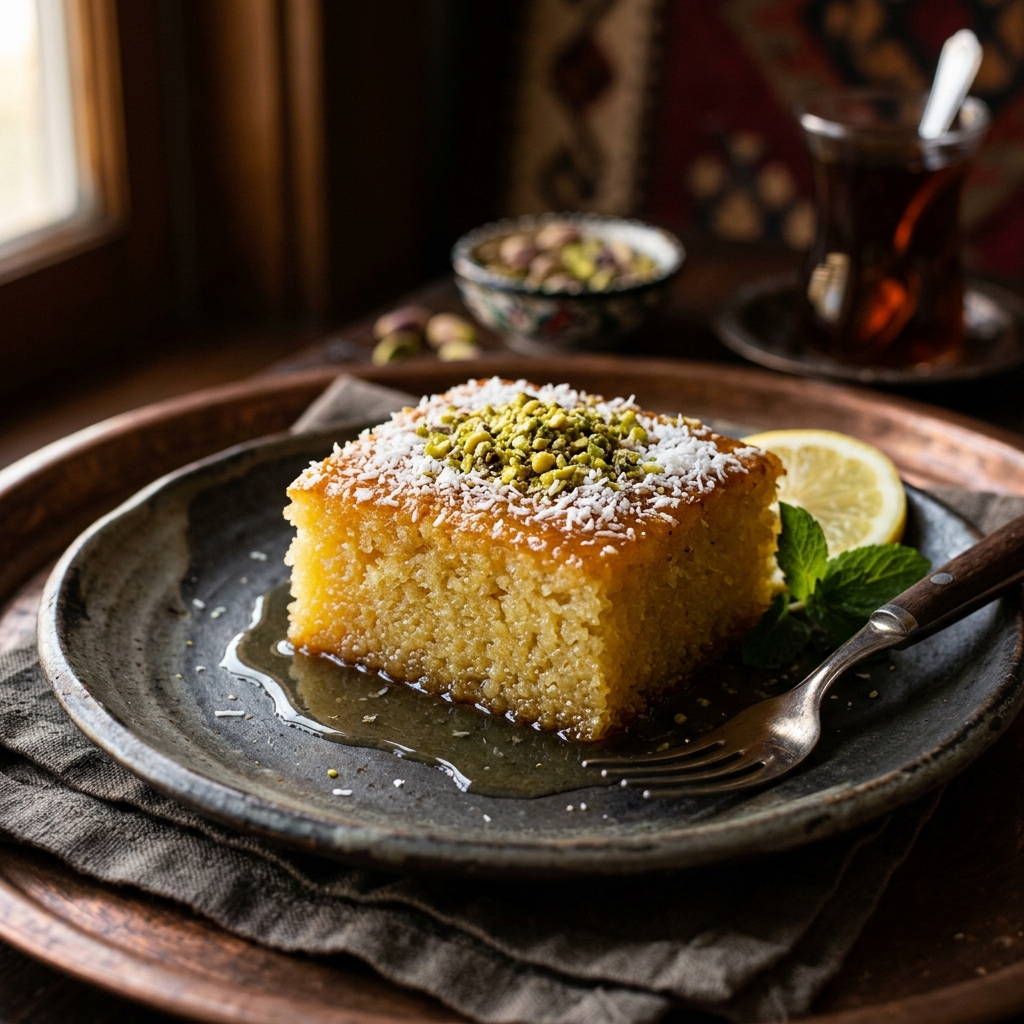
What Is Revani?
Revani is one of the great semolina syrup cakes of the Ottoman confectionery tradition — a cake of coarse, golden semolina and yogurt, soaked in fragrant sugar syrup until each piece becomes moist, dense, and intensely sweet. Simple to make yet extraordinarily satisfying, it is a dessert that appears across the entire former territory of the Ottoman Empire, from Turkey to Greece to Egypt to the Arab world, each culture having adopted it and made it their own while preserving its essential Ottoman character.
Ottoman Origins and the Semolina Tradition
Semolina — coarsely ground durum wheat — has been a staple ingredient in Middle Eastern and Mediterranean cooking for thousands of years, and its use in sweet preparations dates back at least to the medieval Arab culinary tradition. Ottoman palace confectioners elevated semolina desserts to a high art, developing preparations of remarkable sophistication from this simple grain.
The name revani is believed to derive from the name of the city of Revan (modern-day Yerevan, capital of Armenia), which was conquered by the Ottomans in 1635 during the reign of Sultan Murad IV. According to tradition, the dessert was created or named in celebration of this military victory — a confectionery monument to an imperial triumph. Whether or not this etymology is historically verifiable, it reflects the Ottoman practice of naming dishes after significant events, places, or patrons.
The Syrup: The Key to Revani
The defining characteristic of revani — and the element that separates a great revani from a mediocre one — is the syrup. The cake itself is relatively plain: semolina, flour, eggs, yogurt, sugar, and baking powder combined into a batter and baked until golden. But immediately upon emerging from the oven, while still hot, it is drenched in a sugar syrup flavored with lemon juice and sometimes rose water or orange blossom water — and this soaking transforms it completely.
The hot cake absorbs the syrup greedily, becoming dense and moist throughout. As it cools, the syrup sets slightly within the cake, creating a texture that is unlike any dry cake — rich, heavy, and intensely flavored, with a slight resistance to the fork followed by an almost melting quality on the palate. A piece of revani is typically garnished with ground pistachios or coconut and served at room temperature, often accompanied by a glass of strong Turkish tea.
Revani Across Cultures
The spread of revani across the former Ottoman Empire illustrates how powerfully Ottoman culinary culture shaped the food traditions of dozens of modern nations. In Greece it appears as revani or ravani, flavored with orange and coconut. In Egypt it is known as basbousa, made with more semolina and often soaked in honey. In Lebanon and Syria similar preparations are enriched with tahini or rose water. Each version reflects local ingredients and tastes while remaining recognizably part of the same Ottoman culinary family.
📊 Nutrition per Serving
* Approximate values per serving. Recipe makes ~8 servings. Values may vary by ingredients used.
Ingredients
- Cake: 3 eggs
- 1/2 cup sugar
- 1/2 cup vegetable oil
- 1/2 cup yogurt
- 1 cup semolina
- 1 cup flour
- 1 tsp baking powder
- 1 tsp vanilla extract
- Syrup: 3 cups water
- 3 cups sugar
- 1 tbsp lemon juice
Instructions
- First, make the syrup by boiling the water and sugar for 15 minutes. Add lemon juice, boil for 2 more minutes, and let it cool completely.
- For the cake, beat the eggs and sugar until frothy and pale.
- Add the oil, yogurt, and vanilla. Mix well.
- Gradually fold in the semolina, flour, and baking powder until just combined.
- Pour the batter into a greased baking dish (about 9x13 inches).
- Bake at 180°C (350°F) for 25-30 minutes until a toothpick comes out clean and the top is golden.
- Remove from the oven, let it rest for 5 minutes, then cut into diamond or square shapes.
- Pour the cold syrup evenly over the hot cake.
- Let the cake rest for at least 2 hours to absorb all the syrup.
- Serve garnished with a pinch of coconut or ground pistachios on each slice.
The Syrup Rule Every Turkish Baker Knows
All Turkish syrup desserts obey one law: hot meets cold. Either the syrup is cool and the cake is hot, or the cake has cooled and the syrup goes on boiling — never both hot, never both cold. Get it right and the revani drinks the syrup evenly to its heart; get it wrong and you have a soggy top over a dry middle. Pour slowly, ladle by ladle, and then walk away — revani needs a patient hour to absorb before it’s ready.
Why Semolina, Not Just Flour?
Semolina is what separates revani from an ordinary sponge. Its coarse grains stay open as the cake bakes, leaving thousands of tiny channels for syrup to travel through without collapsing the crumb. Flour alone would turn to pudding under that much syrup; semolina keeps its spring. It’s the same logic behind şambali and basbousa — revani’s cousins around the eastern Mediterranean.
Revani FAQ
Does it really get better the next day?
Yes — day-two revani, fully settled and served cool with a spoon of kaymak or clotted cream, is arguably the true revani. It keeps 3–4 days covered at room temperature.
Coconut on top: yes or no?
Both exist. The coconut-dusted version is common in home kitchens and in Balkan variations; pistachio is the more classic finish. Use what your table prefers.
Part of a bigger guide. This recipe also appears in our guide to Turkish desserts and vegetarian Turkish cooking — where you can see how it fits alongside everything else on the table.


Leave a Reply