What Is Sütlaç?
There is something almost meditative about a bowl of sütlaç — the Turkish rice pudding whose simplicity belies its extraordinary depth of tradition. Made from nothing more than rice, milk, sugar, and a little starch, it is a dessert of remarkable purity, its flavor dependent entirely on the quality of its few ingredients and the patience of its preparation. Yet within this apparent simplicity lies one of the longest and most storied culinary traditions in Turkey — a dessert that has graced the tables of Ottoman sultans and ordinary families alike for centuries.
A Dessert Across Civilizations
Rice pudding is one of the oldest prepared desserts in human history, with versions appearing in virtually every culture that cultivated rice. In the ancient world, sweetened rice dishes appear in the culinary records of Persia, India, and China — civilizations that had cultivated rice for thousands of years and developed sophisticated methods of transforming it into celebratory foods.
Rice arrived in Anatolia relatively late — it was not native to the region — but was embraced enthusiastically once introduced through trade routes connecting the Middle East to South and East Asia. By the time of the Ottoman Empire, rice had become a prestigious ingredient in court cooking, and sweetened rice preparations occupied an honored place in the repertoire of Ottoman palace confectioners.
The Topkapi Palace Confectionery
The Ottoman imperial kitchen at Topkapi Palace maintained a separate department dedicated to sweet preparations — the helvahane — staffed by specialized confectioners who produced the desserts served at court banquets and distributed as gifts to dignitaries and soldiers. Rice pudding in various forms was among the preparations produced here, made with the finest milk from palace dairies and sweetened with sugar imported from Egypt and Cyprus.
The palace version of sütlaç was almost certainly richer and more elaborate than the everyday version — thickened with ground almonds or flavored with rose water and mastic — but the essential character of the dish remained constant: a clean, milk-white pudding of extraordinary simplicity and nourishing quality.
Fırın Sütlaç: The Oven-Baked Revolution
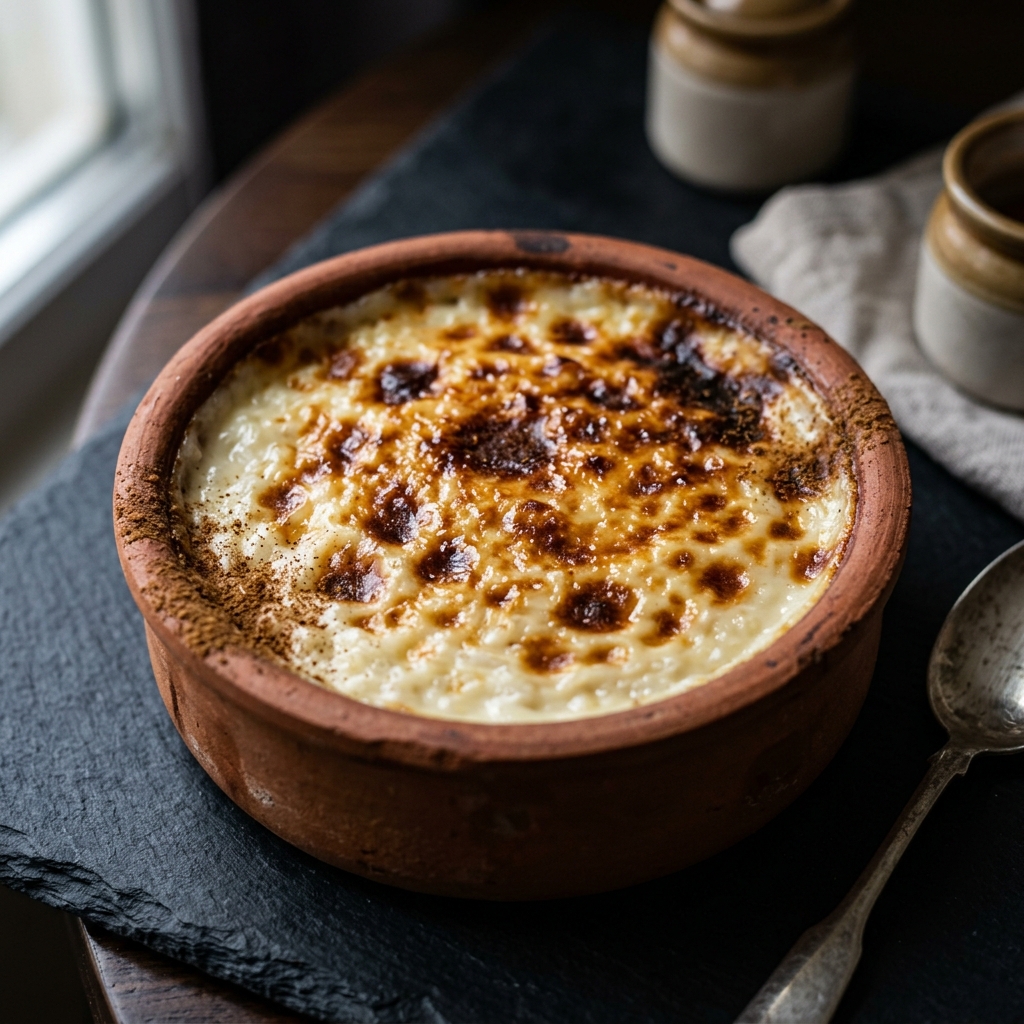
The defining preparation that separates Turkish sütlaç from all other rice puddings in the world is the fırın sütlaç — oven-baked rice pudding. After the pudding is cooked on the stovetop to the desired consistency, it is ladled into individual clay or earthenware bowls and placed in a hot oven — or, in traditional kitchens, under a salamander or broiler — until the surface develops a deeply caramelized, almost burnt skin of extraordinary flavor.
This caramelized top — mottled brown and black, bitter-sweet, with the faint smokiness of toasted milk sugars — is the crowning achievement of fırın sütlaç. It transforms a gentle, milky dessert into something complex and memorable, adding a layer of caramelized depth that contrasts beautifully with the cool, creamy pudding beneath. Achieving the perfect char requires experience and attention: too little and the surface remains disappointingly pale; too much and it becomes unpleasantly bitter.
The Essential Turkish Dessert
Today, sütlaç occupies a unique position in Turkish culinary culture — it is at once the simplest and one of the most beloved of all Turkish desserts. It appears in the windows of milk pudding shops (muhallebici) across Turkey, served cold in individual clay bowls, the caramelized top dark and glossy, dusted perhaps with a little cinnamon. It is the dessert that grandmothers make for sick children — gentle, nourishing, easily digested. It is the dessert that appears at the end of Ramadan iftars, at family celebrations, at ordinary Tuesday dinners when someone simply feels like something sweet and pure.
Its endurance across centuries, its presence at every level of Turkish society, and its ability to comfort and satisfy with such minimal means make sütlaç one of the truest expressions of what Turkish cuisine is at its heart: honest, generous, rooted in quality ingredients, and capable of producing profound pleasure from the simplest of preparations.
If you want the opposite of this baked richness, su muhallebisi is barely set and almost weightless.
📊 Nutrition per Serving
* Approximate values per serving. Recipe makes ~6 servings. Values may vary by ingredients used.
Ingredients
- 1/2 cup short-grain rice
- 2 cups water
- 4 cups milk
- 1 cup sugar
- 3 tbsp cornstarch
- 1 tsp vanilla extract
- Crushed hazelnuts for garnish
Instructions
- Wash the rice and boil it in 2 cups of water until the water is absorbed and the rice is very soft.
- Add the milk (reserving half a cup) and the sugar to the pot with the rice. Bring to a gentle boil.
- Mix the cornstarch with the reserved half cup of cold milk until smooth.
- Slowly stir the cornstarch mixture into the boiling pot.
- Simmer, stirring constantly, until the pudding thickens.
- Stir in the vanilla extract.
- Ladle the pudding into heatproof clay bowls.
- Place the bowls in a deep baking tray. Fill the tray with water halfway up the sides of the bowls.
- Bake on the top rack of the oven under the broiler (high heat) until the tops are dark brown and scorched.
- Refrigerate and serve cold, topped with crushed hazelnuts.
Oven or Stovetop: The Two Schools of Sütlaç
Every Turkish family belongs to one of two camps. Fırın sütlaç goes into clay ramekins and under fierce top heat until the surface blisters brown — that mottled skin is the prize, fought over at the table. Stovetop sütlaç skips the oven for a paler, creamier pudding eaten cold. This recipe gives you the oven version; if you stop before the broil, you’ve simply made the other school’s dessert, and both are correct.
Too Thin? Too Thick? The Rice Knows
- Cook the rice in water first until fully soft — rice added straight to milk never quite surrenders.
- Sütlaç thickens dramatically as it cools; pull it from the heat when it still seems a little loose.
- Too thick the next day? Stir in a few spoonfuls of cold milk and it returns to silk.
The Black Sea Finish
In Rize and Trabzon, sütlaç arrives buried under toasted hazelnuts — a regional touch worth stealing. Cinnamon is the classic elsewhere; some Aegean towns add a violet-scented sprinkle of mastic to the milk.
Sütlaç FAQ
Should I make it on the stovetop or in the oven?
Both are traditional. Oven-baked (fırın sütlaç) gives you the blistered brown skin that most people consider the prize; stovetop gives a paler, creamier pudding eaten cold. Stop before the broiler and you have simply made the other version.
Why is my sütlaç grainy?
The rice went into the milk before it was fully soft. Cook the rice in water first until it yields completely, then let it finish in the milk — rice added raw to milk never softens properly.
Can I use short-grain or pudding rice?
Yes, and it is arguably better — the extra starch gives a creamier result. Avoid parboiled or easy-cook rice, which resists breaking down.
Part of a bigger guide. This recipe also appears in our guide to Turkish desserts and vegetarian Turkish cooking — where you can see how it fits alongside everything else on the table.


Leave a Reply