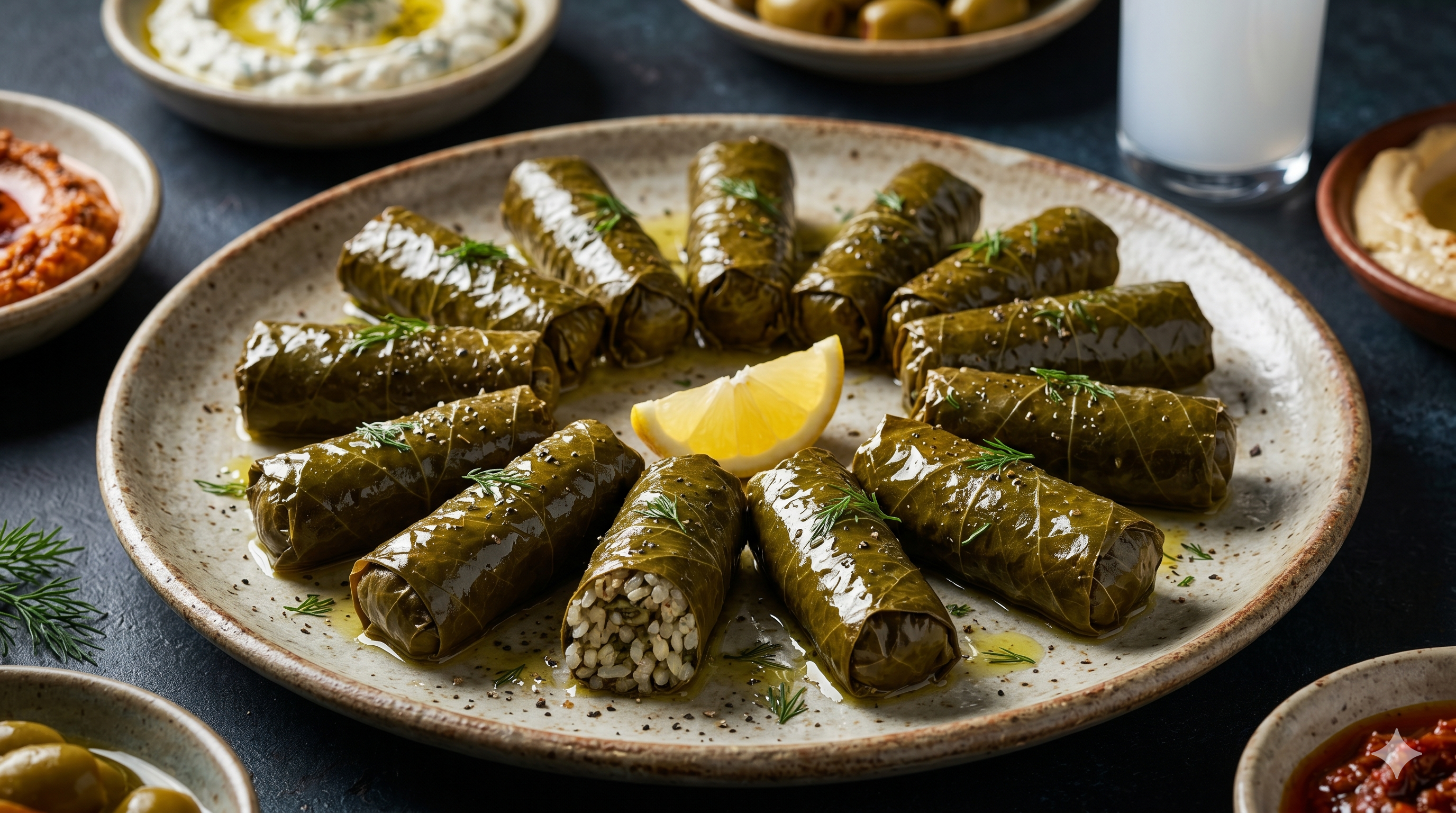
What Is Sarma?
Of all the dishes that grace the Turkish table, few speak as eloquently of shared heritage, cultural generosity, and centuries of culinary exchange as sarma. These delicate rolls — tender grape leaves or cabbage leaves wrapped around a fragrant filling of rice, herbs, and sometimes meat — are at once simple and profound, a dish whose every element tells a story of the civilizations that have passed through Anatolia over thousands of years.
Meaning in the Name
The word sarma comes from the Turkish verb sarmak, meaning “to wrap” or “to roll.” Its companion dish, dolma, derives from dolmak — “to be stuffed.” Together, these two words encapsulate an entire philosophy of Turkish cooking: the idea that humble ingredients — a leaf, a vegetable, a handful of rice — can be transformed into something magnificent through the act of enclosure, of wrapping one thing inside another to create a new whole greater than its parts.
Ancient Origins: From Persia to the Ottoman Palace
The concept of wrapping food in leaves dates to antiquity. Food historians point to ancient Persia as one likely origin for the practice of stuffing vine leaves, noting that Persian cuisine favored the combination of herbs, grains, and spices in wrapped preparations. The ancient Greeks also had a tradition of wrapping food in fig leaves — the thrion — suggesting that the leaf-wrapping impulse was widespread across the ancient Mediterranean and Near East long before the rise of any single empire.
It was the Ottoman Empire, however, that transformed this ancient impulse into the refined, codified dish we recognize today. In the palace kitchens of Topkapi, sarma and dolma evolved into prestigious culinary art forms. Skilled palace cooks competed to roll the smallest, most perfect parcels — a tradition that echoes in Turkey today, where the tightness and uniformity of a sarma’s roll is still considered a mark of the cook’s skill and dedication.
The Spread of a Dish: How Sarma Conquered a Continent
As the Ottoman Empire expanded across Southeast Europe, the Middle East, and North Africa, sarma and dolma traveled with it. In Greece, the dish became dolmades, often served with egg-lemon sauce. In Arab countries, warak enab (grape leaf rolls) became a staple of home cooking. In the Balkans, cabbage sarma became a winter festival food. When Sephardic Jews were expelled from Spain in 1492 and settled in Ottoman territories, they adopted the dish into their own culinary traditions, incorporating it into holiday menus by the 16th century.
This extraordinary geographic spread speaks to one of the great truths of culinary history: food travels with people, and in traveling, it changes while retaining its essential character. Every culture that adopted sarma made it their own — but the thread connecting all these variations leads back to the Ottoman kitchen and, beyond that, to the ancient civilizations of the Near East.
Two Traditions: With Meat and Without
In Turkish cuisine, sarma exists in two distinct traditions that reflect the country’s diverse regional and cultural heritage. Etli sarma — meat sarma — combines rice with minced lamb or beef, spices, and sometimes pine nuts and currants, wrapped in grape leaves and simmered in a tomato-based broth. This version is typically served hot and is associated with festive occasions, family gatherings, and the warmth of winter meals.
Zeytinyağlı sarma — olive oil sarma, served cold — is the zeytinyağlı tradition at its finest: grape leaves wrapped around a filling of rice, herbs, pine nuts, currants, and fragrant spices, cooked in olive oil and lemon juice and served at room temperature. This version, associated with the Aegean coast and the Mediterranean tradition of olive-oil cookery, is considered one of the jewels of Turkish meze cuisine.
The Ritual of Making Sarma
In Turkish households, making sarma is never merely a cooking task — it is a ritual, a form of communal labor that brings families together. Grandmothers teach granddaughters the precise technique of the roll: how to place the filling, how to fold in the sides, how to roll with just the right pressure to create a firm but not tight parcel that will hold its shape through the long, slow cooking process.
The patience required is part of the point. A tray of sarma may contain fifty, seventy, a hundred individual rolls — each one formed by hand, each one a small act of care and attention. In this sense, sarma is not just food. It is a form of love, expressed through the labor of rolling and the pleasure of sharing.
If you like the idea of a dish that a whole village cooks together, keşkek — pounded wheat and lamb — is the other great communal recipe of Anatolia.
📊 Nutrition per Serving
* Approximate values per serving. Recipe makes ~4 servings. Values may vary by ingredients used.
Ingredients
- For the Filling:
- 1 cup short-grain rice
- 1 large onion, finely chopped
- 1/4 cup pine nuts
- 1/4 cup currants or raisins
- 1/2 cup chopped fresh dill
- 1/2 cup chopped fresh parsley
- 1/2 teaspoon ground cinnamon
- 1/2 teaspoon ground black pepper
- Salt to taste
- 1/4 cup olive oil (plus extra for drizzling)
- For the Grape Leaves:
- 1 jar (16 oz) grape leaves, preserved or fresh (about 30-40 leaves)
- 1 lemon, cut into wedges
Instructions
- Prepare the Filling:
- Rinse the rice under cold water until the water runs clear. Drain well.
- In a large pan, heat 1/4 cup of olive oil over medium heat. Add the chopped onion and cook until translucent.
- Add the pine nuts and cook for a few more minutes until lightly toasted.
- Stir in the rice, currants or raisins, dill, parsley, cinnamon, black pepper, and salt. Cook for about 5 minutes, allowing the rice to absorb the flavors. Remove from heat and let the filling cool slightly.
- Prepare the Grape Leaves:
- If using preserved grape leaves, rinse them under cold water to remove excess salt. Blanch them in boiling water for 1-2 minutes to make them pliable. Drain and pat dry.
- If using fresh grape leaves, blanch them in boiling water for 1-2 minutes until they turn a vibrant green. Drain and pat dry.
- Stuff and Roll the Grape Leaves:
- Lay a grape leaf flat on a clean surface, shiny side down. Place a small spoonful of filling in the center of the leaf.
- Fold the sides of the leaf over the filling, then roll from the bottom up, forming a tight cylinder. Repeat with the remaining leaves and filling.
- Cook the Stuffed Grape Leaves:
- Arrange the stuffed grape leaves in a single layer in a large pot or Dutch oven. Place them seam-side down to prevent unrolling.
- Drizzle with additional olive oil and place a few lemon wedges on top. Add enough water to cover the stuffed leaves by about an inch.
- Cover and cook over low heat for 45-60 minutes, or until the rice is tender and the flavors have melded.
- Serve:
- Allow the yaprak sarma to cool slightly before serving. They can be enjoyed warm or at room temperature, often with a side of yogurt or a squeeze of fresh lemon juice.
Afiyet Olsun!
Zeytinyağlı yaprak sarma is more than just a dish; it's a symbol of hospitality and tradition in Turkish cuisine. Its delicate balance of flavors and textures makes it a favorite for both everyday meals and special occasions. Enjoy this taste of Turkish tradition with every bite!
Sarma or Dolma? Settling It
Turks distinguish by verb: dolma is stuffed (peppers, tomatoes — vessels filled), sarma is wrapped (leaves rolled around filling). Grape-leaf sarma is the discipline’s pinnacle: fillings barely a finger thick, rolled tight as cigarettes, lined in a pot like parquet flooring. Thickness is character judgment — the thinner your sarma, the better your reputation, and competitive grandmothers roll them pencil-slim.
Meat or Olive Oil: The Two Schools
Etli sarma carries minced meat and rice, is eaten hot, and answers to yogurt. Zeytinyağlı yaprak sarma — the version on this page — is meatless: rice sweetened with onion, currants and cinnamon, cooked in olive oil, served cool as a meze. Different meals, same wrist technique, and most families keep both in rotation, plus the Black Sea’s kale-leaf cousin.
Rolling School
- Blanch fresh leaves briefly; rinse brined ones well — the brine carries salt enough for three dishes.
- Shiny side down, stem snipped, filling laid as a thin line: fold flanks, then roll firm.
- Firm, not strangled — rice expands, and an over-tightened sarma bursts its jacket.
- Weight the pot with a plate; sarma float and unravel without a chaperone.
- Simmer low and let them rest in the pot before serving — patience sets the roll.
Sarma FAQ
What is the difference between sarma and dolma?
Turks distinguish by verb: dolma is stuffed — peppers, tomatoes, vessels filled. Sarma is wrapped — leaves rolled around a filling. Grape-leaf sarma is the discipline's pinnacle.
Fresh or brined leaves?
Both work. Blanch fresh leaves briefly to soften them; rinse brined leaves thoroughly, since the brine carries salt enough for three dishes.
Why do mine unravel or burst?
Either rolled too loosely, or rolled so tightly the rice had nowhere to swell. Aim for firm but not strangled, and weigh the pot with a plate so the rolls stay put while they simmer.
Part of a bigger guide. This recipe also appears in our guide to Turkish meze and vegetarian Turkish cooking — where you can see how it fits alongside everything else on the table.


Leave a Reply