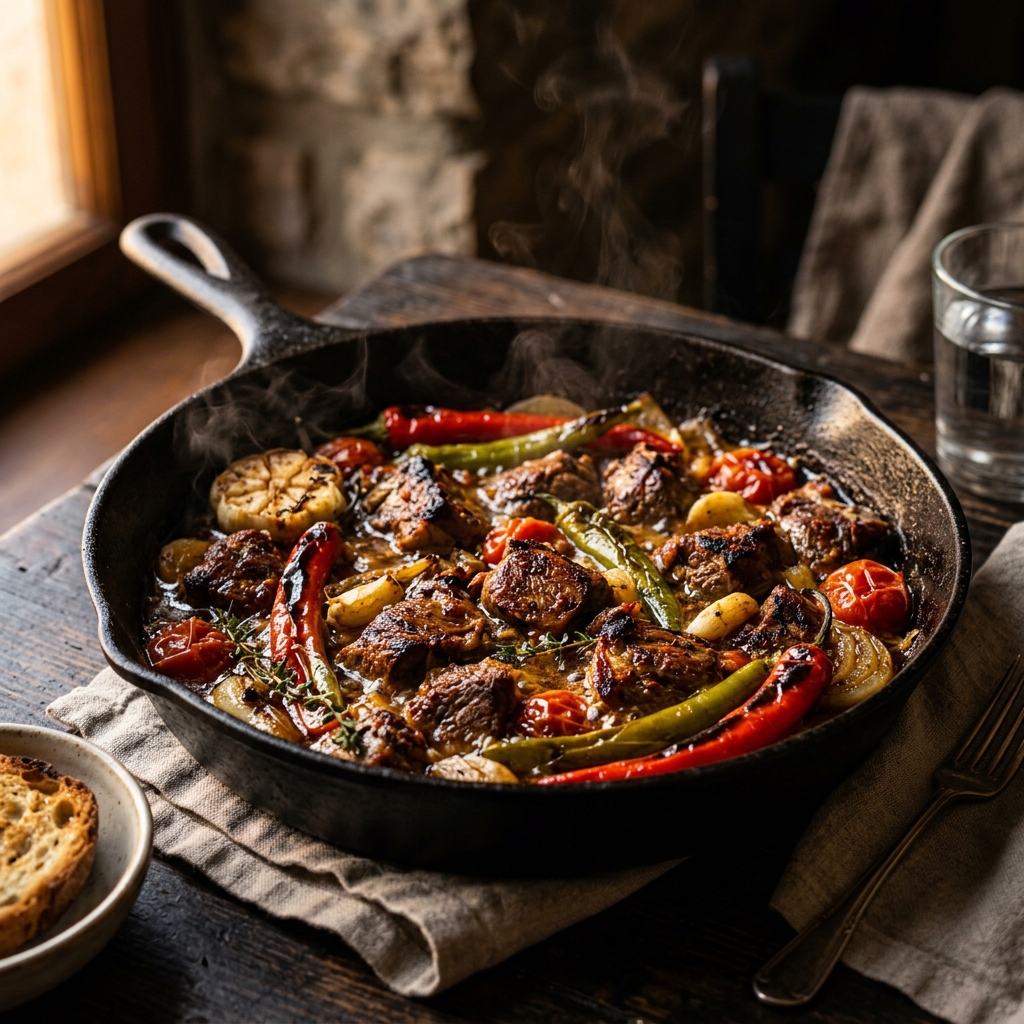
What Is Çoban Kavurma?
Çoban kavurma — shepherd’s kavurma — is the most rustic and elemental of all Turkish meat preparations: lamb or goat cooked over an open fire in its own fat with minimal seasoning, in the tradition of the Anatolian shepherd who has always carried the means of his meal with him in the flock he tends. It is food stripped to its essence — meat, fire, salt, and time — and it achieves in this radical simplicity a purity of flavor that no more elaborate preparation can match.
The Shepherd’s Tradition
For thousands of years, the shepherds of the Anatolian plateau have followed their flocks through the seasons — descending to the valleys in winter, ascending to the highland yaylas in summer — living a semi-nomadic life that required them to be largely self-sufficient in their food. An animal that died or was slaughtered in the field needed to be cooked immediately, with no kitchen equipment beyond a fire and a vessel to cook in. Çoban kavurma emerged from this necessity.
The shepherd’s version of the dish was made in a large, heavy pot — carried on horseback or packed on a donkey — over an open fire of whatever wood was available. The meat was cut into large pieces, the fat rendered first, then the meat cooked in it until done. Salt was the only seasoning. The result, eaten directly from the pot with bread, was one of the most genuinely satisfying meals imaginable: hot meat in rich fat, eaten outdoors after hours of physical labor, with the smell of wood smoke and highland grass in the air.
From Field to Restaurant
This elemental tradition has been embraced and celebrated in Turkish restaurant culture, where çoban kavurma appears as a reminder of the Anatolian pastoral heritage that underlies much of Turkish food culture. In restaurants, the preparation is elevated slightly — the meat cut more precisely, the cooking more controlled — but the essential philosophy remains unchanged: good meat, good fat, fire, and simplicity. In a culinary world that sometimes mistakes complexity for quality, çoban kavurma stands as a quiet, powerful argument for the opposite proposition.
📊 Nutrition per Serving
* Approximate values per serving. Recipe makes ~4 servings. Values may vary by ingredients used.
Ingredients
- 500g lamb, cut into small cubes
- 15-20 small shallots (pearl onions), peeled and left whole
- 3 green peppers, chopped
- 2 tomatoes, peeled and diced
- 2 cloves garlic
- 2 tbsp butter
- 1 tsp thyme, oregano, salt, pepper
- 1/2 cup hot water
Instructions
- Heat the butter in a wide pan or traditional copper ‘sahan’.
- Add the lamb cubes and stir-fry over high heat until they release their juices and brown.
- Add the whole peeled shallots and garlic cloves. Sauté for 5 minutes.
- Add the green peppers and cook for another 3 minutes.
- Stir in the diced tomatoes, thyme, oregano, salt, and pepper.
- Add half a cup of hot water, cover, and reduce the heat.
- Simmer for 30-40 minutes until the meat is meltingly tender and the shallots are soft.
- Serve straight from the pan with crusty bread.
The Shepherd’s Method
Çoban kavurma — “shepherd’s sauté” — is what you cook when the kitchen is a fire, the pantry is a saddlebag, and dinner walked beside you all day. Lamb cut small, fat rendered first, then whatever the day offered: onions, green peppers, tomatoes, a scatter of thyme from the hillside. Its genius is speed and confidence — high heat, few ingredients, no sauce to hide behind.
Çoban, Sac or Sivas: Which Kavurma Are You Making?
Turkey’s kavurma family confuses everyone, so here’s the map: sac kavurma is defined by its pan — the domed griddle. Sivas kavurma is slow meat-in-its-own-fat purity. Çoban kavurma is the loose, vegetable-friendly middle child — closest to what you’d improvise on a Tuesday, which is exactly what it was.
Three Tips from the Hillside
- Render the lamb’s own fat before anything else touches the pan — it’s the flavor base and the cooking oil in one.
- Vegetables go in after the meat has color, so they fry rather than stew.
- Dried thyme or oregano at the end, off the heat — mountain herbs burn fast.
Çoban Kavurma FAQ
Can I use beef instead of lamb?
Yes. Choose a marbled cut and dice it small. Beef cooks a touch faster than lamb, so pull it the moment the pink disappears — this dish punishes overcooking.
Why did mine turn watery?
The pan was too crowded or the vegetables went in too early. Cook the meat in batches so it sears rather than steams, and add tomatoes only after the lamb has taken colour.
What do you serve with it?
Warm flatbread to mop the pan, sumac onions, and a cold glass of ayran. Rice pilavı if you want it to stretch further.
Part of a bigger guide. This recipe also appears in our guide to Turkish kebabs — where you can see how it fits alongside everything else on the table.


Leave a Reply