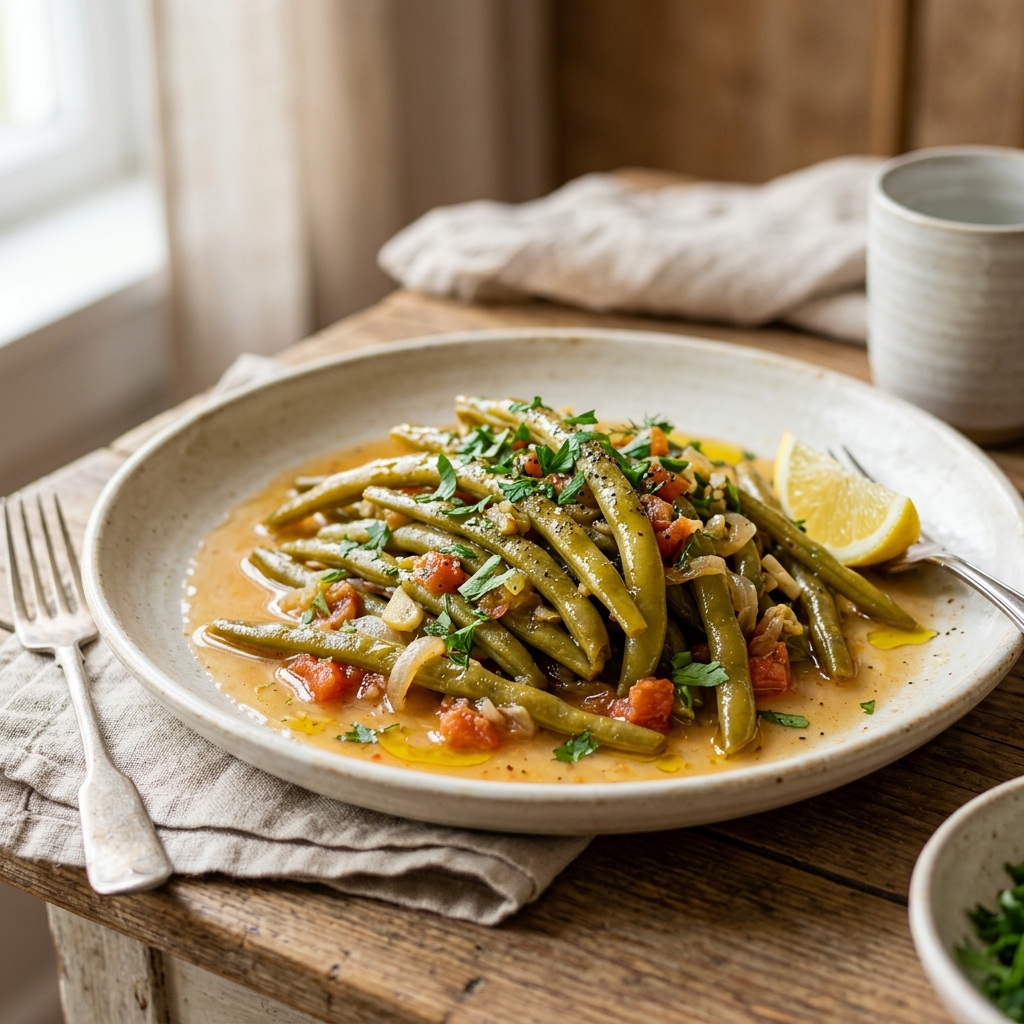
What Is Zeytinyağlı Taze Fasulye?
Zeytinyağlı taze fasulye — green beans in olive oil — is perhaps the most beloved of all Turkish zeytinyağlı dishes: fresh green beans slow-cooked with tomato, onion, and olive oil until completely tender and deeply flavored, served at room temperature as a meze or side dish. It is one of the quintessential tastes of Turkish summer — the beans at their freshest, the tomatoes sun-ripened and sweet, the olive oil rich and fruity — and it is a dish that appears on virtually every Turkish family table during the months when green beans are in season.
The Most Democratic of Dishes
If any single dish could be said to unite all of Turkey across regional, class, and cultural lines, it might be zeytinyağlı taze fasulye. It is made from ingredients available everywhere, it requires no special skill or equipment, it is inexpensive, it is nutritious, and it is — when made with good olive oil and properly ripe tomatoes — genuinely, deeply delicious. It appears on the tables of Aegean fishermen and Istanbul intellectuals, of southeastern village families and Black Sea coast residents, always with slight regional variations in spicing or technique but always recognizable as the same essential dish.
The Technique: Patience and Quality
Great zeytinyağlı taze fasulye requires only two things: patience and quality ingredients. The beans must be cooked long enough to become completely tender — not crunchy, not al dente, but genuinely soft throughout — which requires at least 45 minutes of gentle cooking. The olive oil must be genuinely good — the cheap, flavorless oils that masquerade as olive oil will produce a flat, uninteresting result, while a fruity, well-made extra-virgin olive oil gives the dish its richness and character.
Beyond these two requirements, the recipe is simplicity itself: beans, tomato, onion, olive oil, salt, and perhaps a touch of sugar to balance the acidity. The cooking does the rest — the beans softening and absorbing the tomato sauce, the tomato deepening and sweetening, the olive oil infusing everything with its characteristic richness. It is a dish that teaches the fundamental lesson of good cooking: that simple ingredients, treated with patience and care, always produce the most satisfying results.
📊 Nutrition per Serving
* Approximate values per serving. Recipe makes ~4 servings. Values may vary by ingredients used.
Ingredients
- 500g fresh green beans, trimmed and halved
- 1 large onion, finely chopped
- 3 ripe tomatoes, peeled and grated
- 1/2 cup olive oil
- 1 tsp sugar
- 1 tsp salt
- 1/2 cup hot water
Instructions
- Place the chopped onions in the bottom of a wide pot.
- Layer the green beans evenly over the onions.
- Pour the grated tomatoes over the green beans.
- Drizzle the olive oil over everything. Sprinkle evenly with sugar and salt.
- Do not stir! Cover the pot and cook on low heat for 15 minutes to let the vegetables release their juices.
- Add the hot water, cover again, and simmer on very low heat for 45-60 minutes until the beans are very tender.
- Let the dish cool in the pot to room temperature before serving.
The Dish Every Turkish Home Agrees On
If Turkish home cooking had a flag, green beans braised in olive oil would be on it. It appears on meze spreads in Aegean tavernas, in workplace lunchboxes, at every summer table from Edirne to Van. The formula is calm: beans, onion, tomato, good olive oil, a pinch of sugar, low heat, patience. Like all zeytinyağlılar, it is eaten at room temperature — summer’s answer to stew.
Flat Beans or Round?
Turkish cooks reach for flat, wide romano-type beans (ayşe kadın or çalı), which soften into silk without turning mushy. Standard round green beans work, but they want a few minutes less. Whatever the bean, the old test stands: it should bend and yield, never squeak. Crisp-tender is a virtue in a French kitchen and a scandal in a Turkish one — these beans are meant to be fully, luxuriously soft.
Taze Fasulye FAQ
Why the pinch of sugar?
It rounds the tomato’s acidity and coaxes out the onion’s sweetness — the signature seasoning of the whole zeytinyağlı family. You shouldn’t taste sugar; you should just notice nothing is sharp.
How long does it keep?
Four to five days in the fridge, improving for the first two. It’s the ultimate make-ahead dish — many cooks insist it’s cooked for tomorrow, not today.
Part of a bigger guide. This recipe also appears in our guide to Turkish meze and vegetarian Turkish cooking — where you can see how it fits alongside everything else on the table.


Leave a Reply